Streak CRM review: the Gmail CRM that feels lighter than Salesforce and more practical for email-first teams
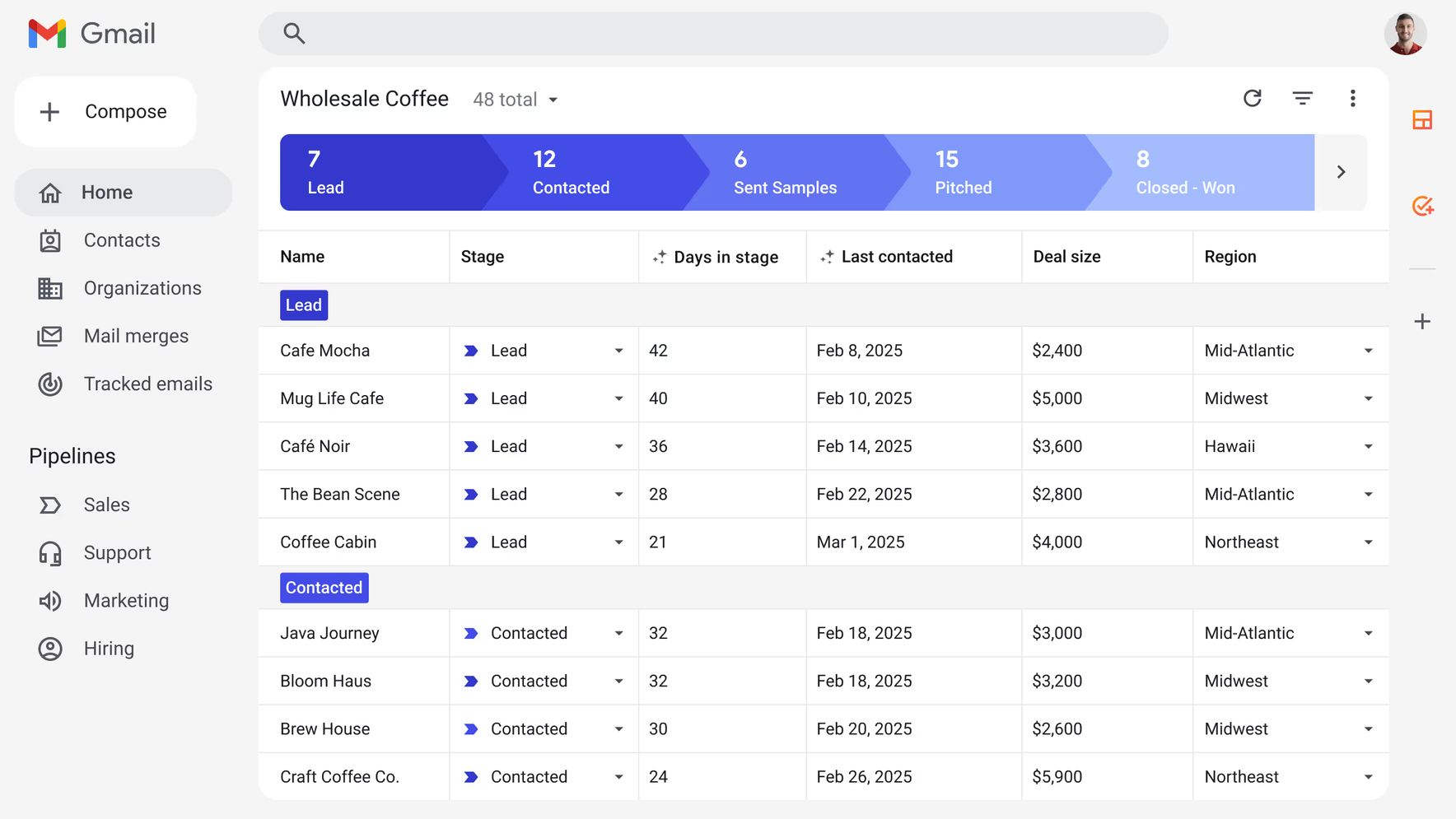
If your work already happens inside Gmail, Streak is one of the most compelling CRM options you can choose. Instead of asking you to live in a separate dashboard all day, Streak runs inside your inbox and turns Gmail into the place where you manage deals, contacts, follow-ups, hiring, support, partnerships, and other relationship-driven workflows.
That core idea is what makes Streak different. Most CRMs add another app, another tab, another login, and another layer of admin work. Streak takes the opposite approach: keep the workflow where your conversations already happen, then add pipeline tracking, collaboration, automation, and AI right there in Gmail.
Why Streak stands out
The best way to understand Streak is to think of it as a CRM for people who hate leaving email. It is built directly into Gmail, and that matters more than it sounds. When your inbox is already where leads, client conversations, recruiting threads, vendor discussions, and partnerships actually live, switching into a traditional CRM can feel like duplicate work. Streak removes that friction by letting you organize emails into pipelines, track deal progress, and collaborate with teammates without jumping into a separate platform.
That makes it especially attractive for solopreneurs, freelancers, agencies, consultants, recruiters, and small teams that want CRM structure without enterprise-level overhead. It also suits operations-heavy teams that manage processes through email rather than through a classic sales floor model.
Streak also integrates naturally with Google Workspace. Beyond Gmail itself, its ecosystem ties into tools like Google Calendar, and its Google Workspace listing describes added functionality in the Gmail mobile app and Calendar as well. The full Streak experience is still most naturally understood as a Gmail-centric, desktop workflow, especially since the Chrome extension is central to how many users get started.
The features that matter most
A lot of CRMs promise automation, but Streak’s most persuasive features are the ones that reduce manual data entry and context switching.
Its current AI layer includes AI Summaries, AI Q&A, and AI Autofill. AI Summaries give you a quick recap of the full deal history, AI Q&A lets you ask deal-related questions from within Gmail, and AI Autofill can scan deal context or public information to update CRM fields automatically. That is a meaningful differentiator because the hardest part of CRM adoption is often not learning the software. It is keeping the data current. Streak is clearly trying to solve that problem.
Outside the AI features, Streak also supports practical email-first workflow tools like lead tracking, follow-up support, email organization, and mail merge capabilities from within Gmail. In plain English, it is designed for teams that want less admin and faster execution.
Who Streak is best for
Streak makes the most sense when email is already the operational center of your business.
If you are a freelancer or consultant, Streak can help you keep prospects, proposals, clients, and follow-ups organized without forcing you into a heavy sales system. If you run an agency, it can work well for tracking new business, active client communication, partnerships, and renewals. If you recruit, hire, or manage outbound relationship-building, it is easy to see how a Gmail-native pipeline could fit better than a bloated CRM that was really designed for large sales orgs.
This is also why Streak often appeals to teams that have rejected traditional CRMs in the past. The software does not ask people to change where they work. It meets them inside the inbox they are already using.
Where Streak fits compared with traditional CRMs
The simplest way to position Streak is this: it is not trying to be the most sprawling enterprise CRM on the market. It is trying to be the CRM your team will actually use.
That is an important distinction. Platforms like Salesforce can be incredibly powerful, but for many smaller teams they also come with heavier setup, more customization overhead, and more process than the business really needs. Streak’s pitch is lighter, faster, and more email-native. It is a better fit when your priority is staying close to conversations and reducing admin burden, rather than building a deeply customized system across multiple business units.
That does not mean Streak is automatically better for everyone. If you need a massive multi-team CRM with complex reporting, permissions, and company-wide process design, you may still prefer a more traditional platform. But if your main problem is that your current CRM feels like extra work, Streak is exactly the kind of alternative worth considering.
What the real-world case studies show
Two case studies are especially useful because they show Streak solving practical problems, not just sounding good in a feature list.
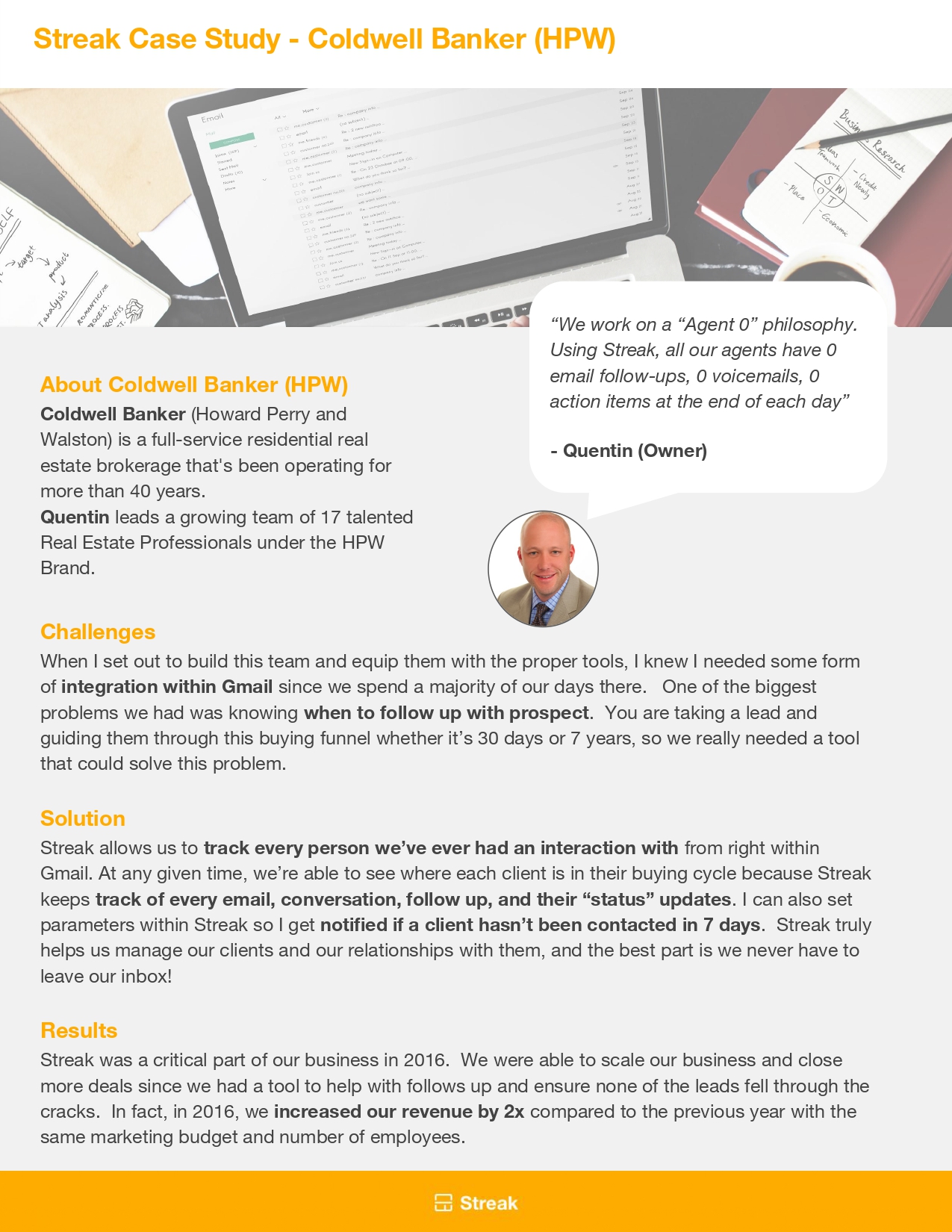
At Coldwell Banker (HPW), the team needed a better way to manage long lead cycles and make sure follow-ups did not get missed. Their work already revolved around Gmail, so they needed a tool that fit directly into that workflow. According to the case study, Streak let them track every interaction inside Gmail, monitor where each client was in the buying cycle, and set notifications when a client had not been contacted in seven days. The result was not just better organization. It had a measurable business impact: in 2016, they doubled revenue year over year while keeping the same marketing budget and the same number of employees. Quentin, the owner, also described an “Agent 0” philosophy in which agents ended the day with 0 email follow-ups, 0 voicemails, and 0 action items.
That is a strong example because it shows Streak doing what a good CRM should do: protecting revenue by making follow-up consistent.
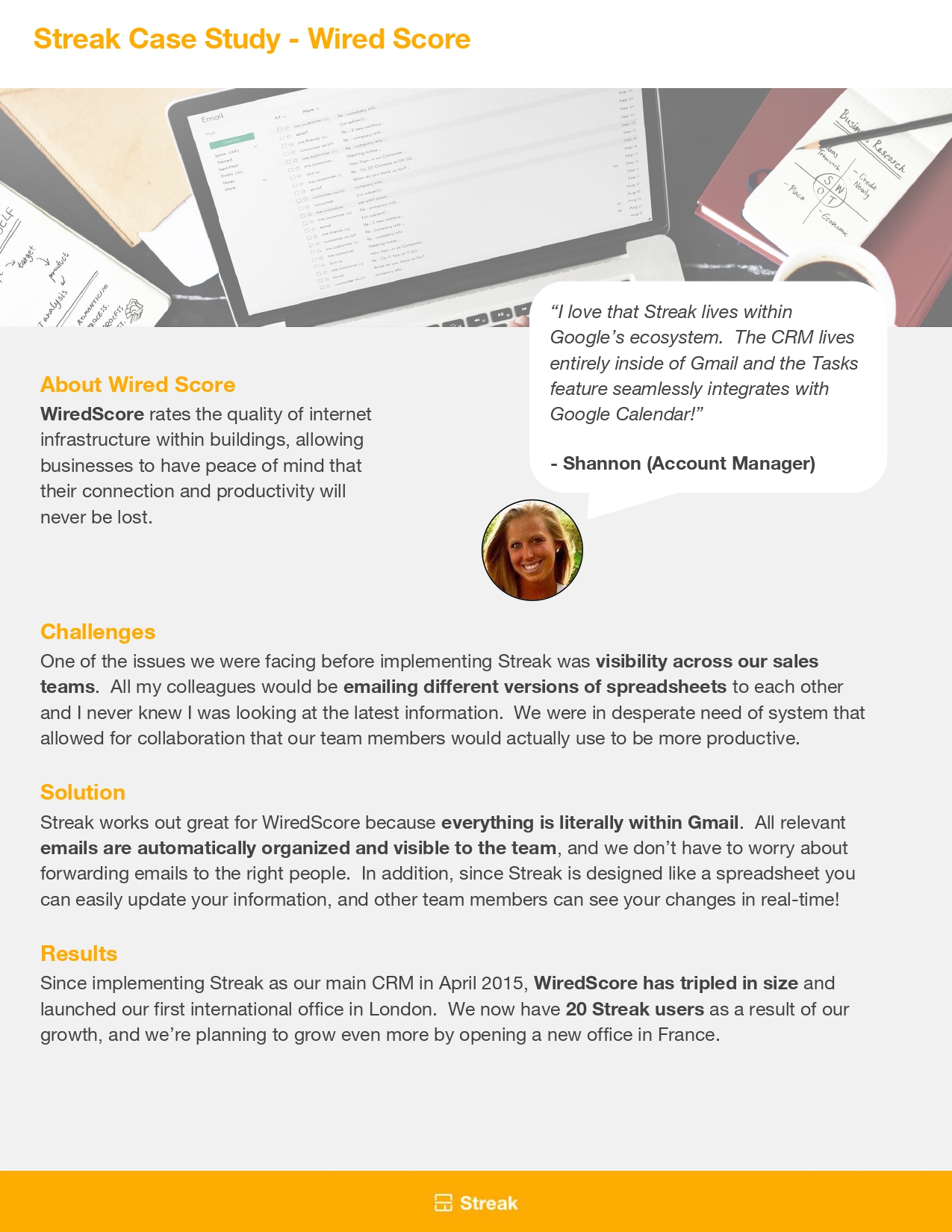
The WiredScore case study highlights a different strength: team visibility and collaboration. Before implementing Streak, they struggled with multiple spreadsheet versions and poor visibility across the sales team. Streak solved that by organizing relevant emails inside Gmail and making updates visible to the team in real time. According to the case study, since adopting Streak as its main CRM in April 2015, WiredScore tripled in size, launched its first international office in London, and grew to 20 Streak users, with plans to expand further into France. Shannon, an account manager, specifically praised the fact that Streak lives inside Google’s ecosystem and integrates seamlessly with Gmail and Google Calendar.
Taken together, these case studies make a persuasive argument. Streak is not just a convenience tool. In the right environment, it can improve follow-up discipline, reduce coordination friction, and help teams scale without adding unnecessary complexity.
The AI angle is one reason Streak is more relevant now
There are plenty of CRM tools that can track a pipeline. What makes Streak more interesting right now is that it is pushing AI into the actual inbox workflow.
That matters because salespeople, founders, recruiters, and account managers usually do not fail at CRM because they do not understand stages or fields. They fail because updating records is tedious. Streak’s AI features are meant to solve exactly that problem. AI Summaries reduce the time needed to understand account history, AI Q&A helps surface context before replying, and AI Autofill helps populate fields without as much manual entry.
For buyers comparing tools, this is one of the strongest reasons to look closely at Streak right now. It is not just “CRM inside Gmail.” It is increasingly “AI-assisted CRM inside Gmail,” which is a much more compelling pitch for busy teams.
The honest downside
Streak is strongest when your process truly lives in Gmail and Google Workspace. That is its superpower, but it also defines its limits.
If your company works across many systems, needs deep enterprise reporting, or wants a CRM to serve as a central operating system far beyond email, Streak may feel too lightweight. And if your team is not deeply tied to Gmail, its biggest advantage becomes less meaningful.
In other words, Streak is not the best CRM for every business. But it may be one of the best CRMs for email-first businesses.
Final take
Streak is easy to recommend to people who want a CRM that feels practical instead of performative. Its biggest strength is not that it has more features than everyone else. It is that it reduces the friction that causes most CRM implementations to fail in the first place.
If you live in Gmail, want better visibility across deals and conversations, and like the idea of AI helping keep your pipeline updated, Streak is worth serious attention. The Coldwell Banker and WiredScore case studies reinforce that this is not just a neat inbox add-on. In the right hands, it can materially improve follow-up, collaboration, and growth.